- Phone: (031) 849 5566
- WA: +6282140060234
- Email: [email protected]
- Hours: Mon-Fri, 8am - 5pm
Understanding Odoo: An Integrated ERP Solution for Business Efficiency and Digital Transformation
In today’s digital era, more and more companies are adopting Enterprise Resource Planning (ERP) systems to manage their operations in an integrated, efficient, and data-driven way. One of the widely used platforms is Odoo, which is known for its flexibility, ease of use, and comprehensive modules that support various business needs.
Understanding Odoo as a Modern ERP Solution
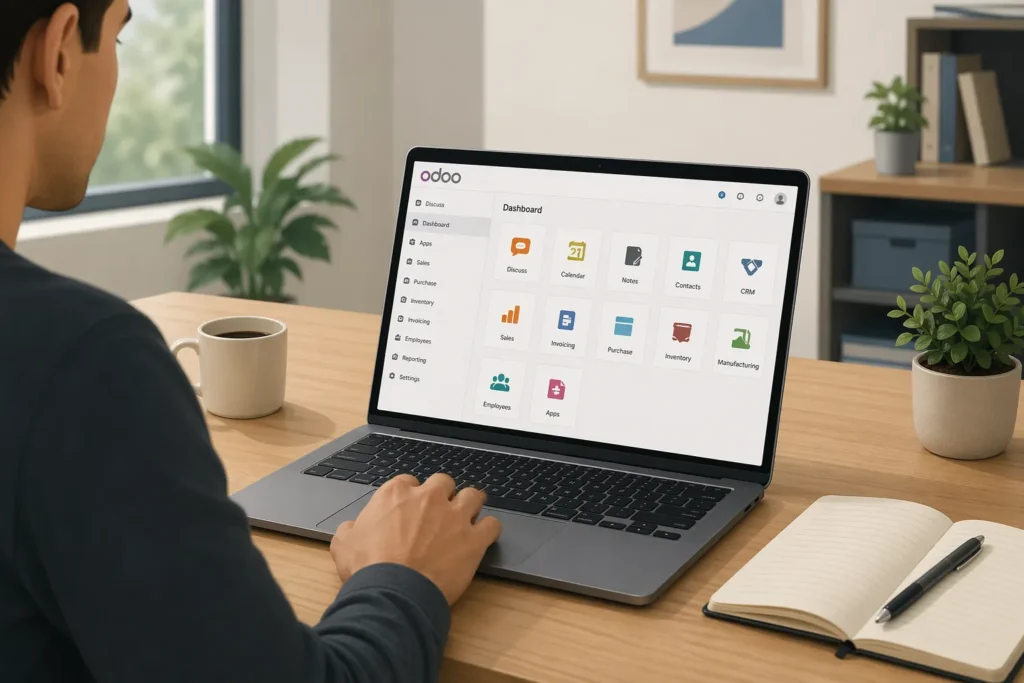
Odoo is an open-source ERP solution that offers a wide range of business applications within one integrated ecosystem. Moreover, Odoo uses a modular approach, allowing companies to select and use features based on their specific needs.
Odoo delivers key advantages through its ease of use, flexibility, and customization capabilities. In addition, the system supports various industries, including service companies, trading businesses, manufacturing firms, and growing startups. Furthermore, Odoo enables seamless integration between modules. This means that data entered in one process directly impacts related processes. For example, a sales transaction automatically records in the accounting system, thereby reducing duplicate data entry and improving data accuracy.
Also Read: Business Operations Optimization through ERP Implementation
Comprehensive Odoo Features to Support Business Needs
As an integrated ERP system, Odoo provides a wide range of business applications categorized based on core business functions, including finance, sales, operations, and productivity. The following are the main feature categories:
- Finance
Odoo provides financial modules that include accounting, invoicing, tax management, and a multi-currency system to support global transactions. As a result, companies can manage financial reports, journals, and tax compliance within a single integrated system. - Sales
The sales module in Odoo supports the entire sales process, from quotation creation to invoice generation. Additionally, it connects directly with other modules such as CRM and accounting, ensuring a seamless and efficient sales workflow. - Website
Odoo offers a website builder that enables companies to create and manage websites easily. Furthermore, it supports integration with e-commerce, blogs, and customer portals within one platform. - Supply Chain
From an operational perspective, Odoo provides modules such as inventory, manufacturing, and maintenance to manage the supply chain. Consequently, companies can control stock levels, production processes, and product quality more effectively. - Human Resource (HR)
Odoo also includes HR modules covering employee management, attendance, payroll, and recruitment processes. Therefore, companies can manage the employee lifecycle in a more structured and integrated way. - Service
For service-based businesses, Odoo offers modules such as project management, timesheets, helpdesk, and field service. As a result, companies can improve service delivery and customer satisfaction. - Productivity
Odoo is equipped with productivity tools such as documents, spreadsheets, e-signatures, dashboards, and internal communication. Thus, team collaboration becomes more effective within a centralized platform. - Studio
Odoo Studio allows users to customize applications. For instance, users can create new fields, modify interfaces, and build automation tailored to their business needs.
Overall, these features are fully integrated, creating efficient workflows with minimal duplication. In addition, companies can add new modules as they grow, making Odoo a highly scalable solution.
The Role of Consultants in ERP Implementation
ERP implementation is fundamentally an operational transformation process that involves not only technology but also adjustments to business processes. In practice, many companies face challenges such as misaligned workflows, unstandardized data quality, and suboptimal system utilization after implementation.
At this stage, the role of a consultant becomes critical in ensuring that the ERP system is implemented effectively and truly supports operational needs. As a consulting firm, PT Synergy Ultima Nobilus (PT SUN) provides ERP implementation services that focus on practical execution, a systematic approach, and business-oriented solutions.
Business Process Mapping and System Requirement Analysis
PT SUN conducts a comprehensive mapping of existing business processes, including workflows in finance, sales, procurement, and operations. Subsequently, this process aims to identify gaps between current practices and ERP system requirements. The results of this analysis then serve as the foundation for configuring a system aligned with the company’s actual conditions.
Also Read: The Strategic Role of Flowcharts in Accounting Information System Design
System Configuration and Data Preparation
PT SUN configures the ERP system based on the business process mapping results, including chart of accounts setup, master data structuring, approval workflows, and operational parameters. In addition, PT SUN supports data preparation and standardization to ensure smooth migration into the system. This step is crucial to ensure high-quality data as the foundation for business operations.
User Assistance and System Optimization
PT SUN provides ongoing assistance to users in performing daily operational activities. This support includes system usage guidance, issue resolution, and workflow adjustments. Furthermore, periodic evaluations are conducted to ensure the ERP system continues to operate effectively and contributes to improved operational efficiency.
Contact us for further consultation!