- Phone: (031) 849 5566
- WA: +6282140060234
- Email: [email protected]
- Hours: Mon-Fri, 8am - 5pm
Green Commitment: 5 Key Channels of Sustainability Communication
In the modern business era, sustainability is a strategic commitment that defines a company’s trustworthiness, reputation, and competitiveness. However, commitment alone is not enough. Companies must also communicate their sustainability initiatives effectively so that their message and values are clearly understood by stakeholders.
What Is Sustainability Communication?
Sustainability communication is the process of delivering information about a company’s Environmental, Social, and Governance (ESG) practices to various stakeholders, including investors, customers, employees, and the community.
Unlike regular marketing activities, sustainability communication does not focus on promotion but rather on transparency and accountability. Its main objectives are to:
- Provide clear and accurate information,
- Build engagement with stakeholders, and
- Strengthen trust in the company’s sustainability commitment.
Sustainability communication is becoming increasingly important as stakeholder demands for transparency continue to grow. Companies are now expected to report not only their financial performance but also the social and environmental impact of their business activities. Through open and honest communication, organizations can enhance their reputation and build public trust. Furthermore, effective communication attracts investors and customers who are more aware and concerned about sustainability issues, helping create long-term value for both business and society.
Sustainability Communication Channels
| Channel | Who Is Affected? | Purpose |
|---|---|---|
| Sustainability Reports | Stakeholders, Investors, Regulators | Provide standardized ESG data, build trust, ensure compliance |
| Company Websites & Social Media | Customers, Communities, NGOs, General Public | Raise awareness, share updates, demonstrate transparency |
| Press Releases & Newsletters | Media, Customers, Investors | Highlight key achievements, announce commitments, manage reputation |
| Stakeholder Forums & Dialogues | Regulators, NGOs, Communities, Employees | Foster two-way communication, gather feedback, address concerns |
| Sustainability Campaigns & Events | Customers, Communities, Employees, NGOs | Educate, inspire engagement |
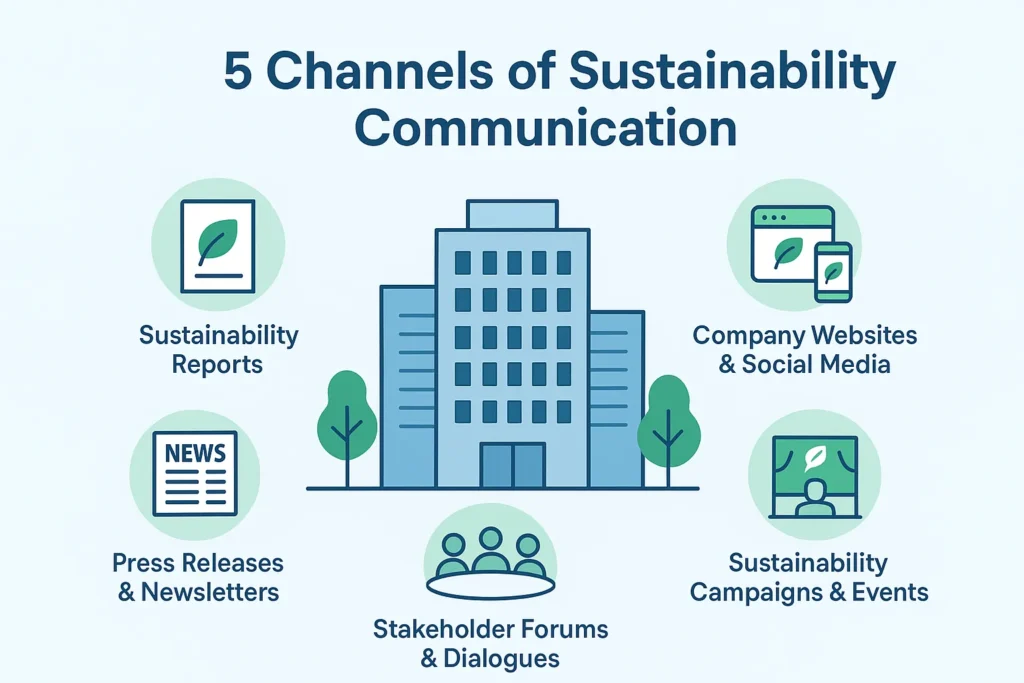
The five main channels that companies can use to deliver their sustainability messages effectively are summarized below:
1. Sustainability Reports
Sustainability reports represent a company’s transparency in disclosing its ESG performance and achievements in a structured manner. These reports serve as a key reference for investors, regulators, and other stakeholders to assess how committed the company is to sustainable business practices and how its operations impact society and the environment.
In preparing such reports, many companies refer to international standards such as the Global Reporting Initiative (GRI) and the IFRS Sustainability Disclosure Standards (IFRS S1 and S2) issued by the International Sustainability Standards Board (ISSB). These frameworks help ensure that sustainability reports are transparent, relevant, and comparable across industries and jurisdictions.
2. Company Websites and Social Media
Official websites and social media platforms are fast, broad, and interactive communication channels. Through these media, companies can share program updates, social initiatives, and environmental achievements transparently while raising awareness about sustainability values.
3. Press Releases and Newsletters
Press releases and newsletters serve to communicate key information to the media, customers, and investors. They are effective for announcing new sustainability projects, ESG milestones, or strategic partnerships that support the company’s green agenda.
4. Stakeholder Forums and Dialogues
Forums and dialogues play a vital role as two-way communication channels. These interactions allow companies to listen to feedback, address concerns, and strengthen trust-based relationships with government bodies, communities, and social organizations.
5. Sustainability Campaigns and Events
Sustainability campaigns and events are powerful tools for education and inspiration. By involving communities, employees, customers, and NGOs, such activities strengthen corporate reputation while encouraging active participation in collective sustainability goals.
Read also: Merger vs Acquisition: A Practical Guide for Growing Companies
Challenges in Sustainability Communication
Despite its importance, managing sustainability communication is not without challenges. Common issues that companies face include:
- Risk of Greenwashing
Companies must be cautious not to fall into the trap of greenwashing—communicating environmentally friendly messages that are not backed by real actions.
Currently, there is no specific regulation addressing greenwashing in Indonesia. Such cases are usually handled under general provisions in the Consumer Protection Law No. 8 of 1999. - Data Limitations and Verification Processes
Collecting sustainability data requires consistent and auditable reporting systems to ensure the information presented is valid and reliable. - Balancing Financial and Non-Financial Information
Good sustainability communication not only highlights financial performance but also social, environmental, and governance impacts. - Different Stakeholder Priorities
Each stakeholder group has distinct priorities. The challenge for companies is to craft relevant messages for all audiences without losing consistency.
Conclusion
Sustainability communication is a crucial element in building trust and accountability between companies and the public. To be effective, it must be transparent, consistent, and stakeholder-focused. As public awareness of environmental issues continues to grow, a company’s ability to credibly communicate its sustainability commitment becomes a strategic advantage that differentiates genuinely sustainable businesses from those that are merely green in appearance.
References
Global Reporting Initiative. (2021). GRI standards: Sustainability reporting guidelines. Global Reporting Initiative. https://www.globalreporting.org
World Business Council for Sustainable Development. (2020). The road to credible sustainability communication. WBCSD. https://www.wbcsd.org
Organisation for Economic Co-operation and Development. (2018). OECD due diligence guidance for responsible business conduct. OECD Publishing. https://www.oecd.org
United Nations Global Compact. (2023). Communication on progress. UNGC. https://unglobalcompact.org