- Phone: (031) 849 5566
- WA: +6282140060234
- Email: [email protected]
- Hours: Mon-Fri, 8am - 5pm
Article 22 Tax for Marketplace sellers: Which Certificate Do You Need?
The Directorate General of Taxes (DGT) has officially postponed the schedule for Article 22 Income Tax withholding by marketplaces until October 31, 2026. Therefore, the provision will only take effect starting November 1, 2026. This postponement gives merchants time to understand the applicable provisions. These provisions include the Statement Letter and Tax Collection Exemption Certificate (SKB) for Article 22 Income Tax withholding exemptions.
Since Minister of Finance Regulation (PMK) No 37 of 2025 established marketplaces as withholding agents for Article 22 Income Tax, many merchants have started questioning which documents they need to prepare and whether all merchants will receive the same tax treatment.
The tax treatment for each merchant may differ depending on their circumstances and applicable tax provisions. Therefore, it is important to understand the two exemption routes for Article 22 Income Tax withholding: the Statement Letter and the SKB. This article discusses the differences between these two routes, as well as the withholding scheme for each merchant category.
Read Also: Tax Exemption Certificate (SKB) on Marketplace: Definition & How to Activate It
Two Exemption Routes: Statement Letter vs SKB
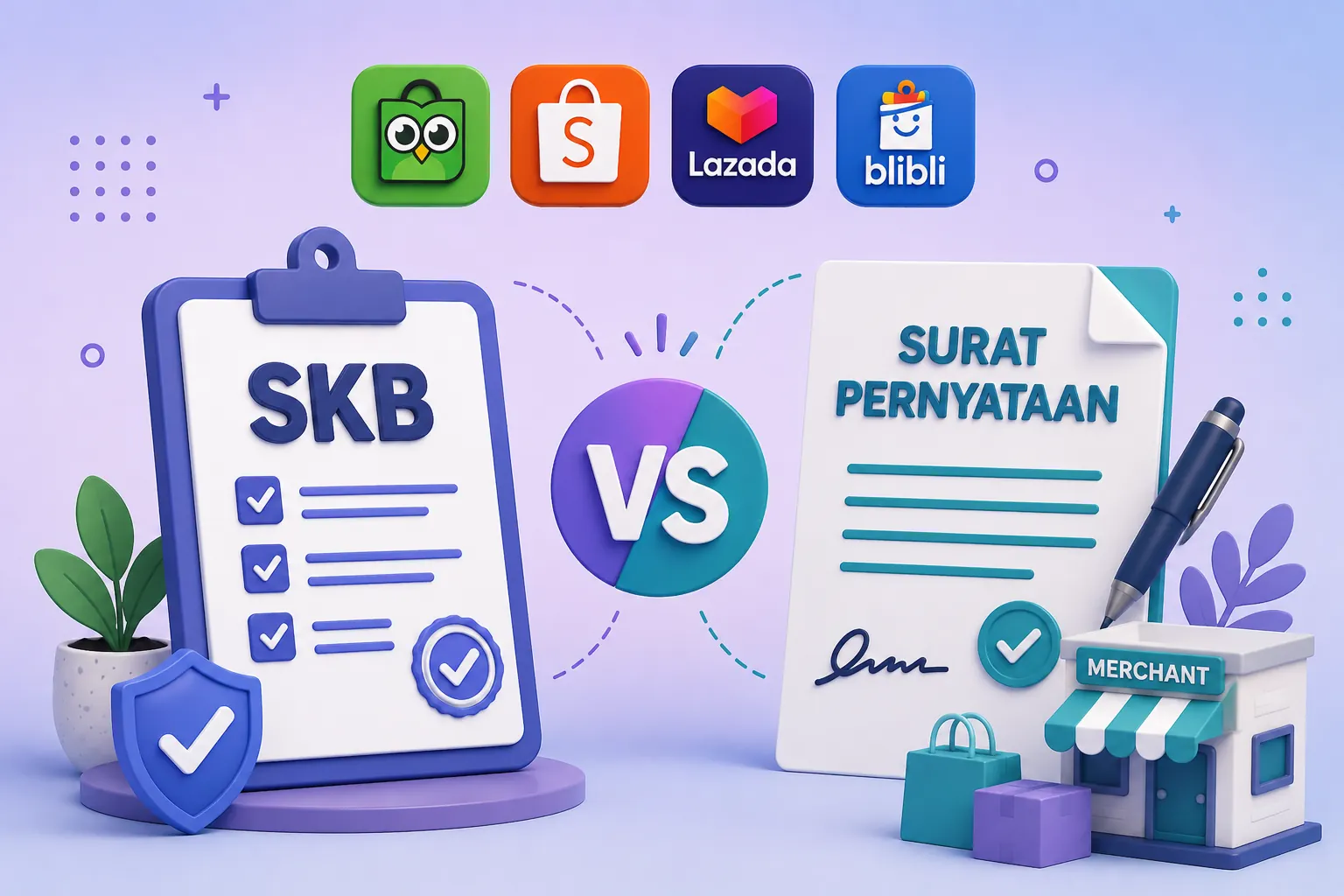
Many merchants assume that all forms of exemption from Article 22 Income Tax withholding is called an “SKB.” In fact, PMK 37/2025 provides two different routes, each with a different process.
1. Turnover Statement Letter (for MSMEs with Annual Turnover of ≤ IDR 500 Million)
Individual merchants with annual turnover of up to IDR 500 million are not subject to Final Income Tax because they receive a tax-free turnover facility. This taxpayer is not required to provide a Tax Exemption Certificate (SKB) from the Tax Office (KPP). The merchant only needs to submit a stamped turnover statement letter directly to the marketplace, stating that their annual turnover does not exceed IDR 500 million. Based on this statement, the marketplace will not withhold Article 22 Income Tax.
2. Tax Collection Exemption Certificate / SKB (Issued by DGT)
Unlike the Statement Letter, the SKB is an official document issued by the DGT. Merchants must apply for the SKB through the Tax Office (KPP). This route applies to both individual and corporate merchants who can prove that no Income Tax will be payable. For example, the merchant may have a fiscal loss or may have recently established the business. Once issued, the merchant must upload the SKB to their seller account on the marketplace. Detailed requirements and the SKB application process are discussed in our article Tax Exemption Certificate (SKB) on Marketplace: Definition & How to Activate It.
| Aspect | Turnover Statement Letter | Tax Exemption Certificate (SKB) |
|---|---|---|
| Issued by | Merchant themselves (stamped) | Directorate General of Taxes (DGT) |
| Submitted to | Directly to the marketplace | Tax Office (KPP), then uploaded to the marketplace |
| Who is eligible | Individuals, turnover ≤ IDR 500 million/year | Individuals or entities, under certain conditions (fiscal losses/tax overpayments/newly established) |
| Legal basis | PMK 37/2025 | PMK 37/2025 & PER-8/PJ/2025 |
Read Also: PMK 37/2025: Marketplaces Officially Appointed as Withholder Article 22
Differences in Article 22 Income Tax Withholding by Taxpayer Type
The Article 22 Income Tax withholding mechanism for merchants depends on the type of taxpayer and the applicable tax scheme. In general, withholding can be divided into three groups:
Individual MSME Merchants — 0.5% Final Income Tax Scheme
1. Annual Turnover of Up to IDR 500 Million
No Final Income Tax is imposed because the merchant is eligible for a tax exemption facility on its turnover. By submitting a turnover statement letter to the marketplace, online sellers will not have Article 22 Income Tax withheld. However, once cumulative turnover within a tax year exceeds IDR 500 million, the taxpayer must submit a new Statement Letter. The marketplace will then withhold Article 22 Income Tax at 0.5% starting from the following month as settlement of the Final Income Tax.
2. Annual Turnover Above IDR 500 Million up to IDR 4.8 Billion
The marketplace will withhold 0.5% Final Income Tax on the portion of turnover that is subject to Final Income Tax in accordance with the applicable tax provisions.
Merchants Under the Non-Final Income Tax Scheme
This category applies to merchants using the Non-Final Income Tax scheme, such as corporate taxpayers, individual taxpayers who choose formal bookkeeping, or individual taxpayers with annual turnover exceeding IDR 4.8 billion. Unlike the MSME scheme, this group does not use a Statement Letter. Article 22 Income Tax withholding for this group is set at 0.5% of gross turnover. However, this withholding is not a final tax and can be credited against the tax payable reported in your Annual Income Tax Return.
Exemption from Article 22 Income Tax Collection
Merchants who hold a Tax Collection Exemption Certificate (SKB) and have submitted it to the marketplace will not be subject to Article 22 Income Tax withholding. The SKB must still be valid and must be submitted before the transaction takes place.
Conclusion
Choosing the appropriate route, whether a turnover statement letter or an SKB, depends on each merchant’s profile and financial circumstances. Small MSMEs with annual turnover below IDR 500 million only need to submit a stamped turnover statement letter to the marketplace. Meanwhile, merchants with specific conditions, (fiscal losses, tax overpayments, or newly established/producing), need to obtain an official SKB. Understanding these differences from the beginning can help merchants avoid unnecessary Article 22 Income Tax withholding.
If you are still unsure which route is appropriate for your business or need assistance with calculating and reporting your Article 22 Income Tax obligations, the Synergy Ultima Nobilus team is ready to assist — Contact Us for further consultation.
Editorial Credits
Written by: SHL
Edited and reviewed by: ECK