
- Phone: (031) 849 5566
- WA: +6282140060234
- Email: [email protected]
- Hours: Mon-Fri, 8am - 5pm
Government Regulation No. 20 of 2026: Key Changes to the 0.5% Final Income Tax Rate
Many business owners have relied on the 0.5% Final Income Tax rate to simplify their tax compliance. Through Government Regulation No. 20 of 2026 (or what people in Indonesia call GR 20/2026), the Government has retained this preferential tax rate. However, the regulation also introduces several changes that affect its eligibility requirements. Therefore, business owners should understand these changes to develop an appropriate tax strategy while minimizing potential compliance risks.

GR 20/2026: What Has Changed?
GR 20/2026 introduces several important changes for taxpayers that apply the 0.5% Final Income Tax rate. Below are the key provisions that deserve attention.
Individual Taxpayers May Apply the 0.5% Final Income Tax Rate for a Longer Period
One of the most significant changes removes the time limit for Individual Taxpayers to apply the 0.5% Final Income Tax rate. Previously, Article 59 paragraph (1) of Government Regulation No. 55 of 2022 limited the application of this rate to seven fiscal years. Now, Individual Taxpayers may continue applying the rate as long as they meet the applicable requirements or have not elected to use the general income tax regime.
The Scope of Eligible Taxpayers Has Narrowed
GR 20/2026 also limits the categories of taxpayers eligible to apply the 0.5% Final Income Tax rate. Previously, various business entities could apply the rate if they met the prescribed gross revenue threshold. Under Article 57 of GR 20/2026, the rate now generally applies only to Individual Taxpayers, One-Person Limited Liability Companies (Perseroan Perorangan), and cooperatives. Consequently, newly established limited partnerships (CV) and limited liability companies (PT) must calculate their Corporate Income Tax under the general tax regime or apply the Article 31E facility if they meet the relevant requirements.
Gross Revenue Calculation Has Become More Comprehensive
The regulation also changes how businesses calculate the IDR 4.8 billion gross revenue threshold. Businesses must now include their total gross revenue, including income subject to non-final income tax and business income earned overseas. As a result, taxpayers that previously met the threshold may no longer qualify under the revised calculation method.
For example, a consulting firm generates IDR 4.2 billion in domestic service revenue and earns an additional IDR 900 million from overseas consulting services. Under GR 20/2026, the firm must include both income streams when calculating its gross revenue. Consequently, its total gross revenue reaches IDR 5.1 billion, making it ineligible to apply the 0.5% Final Income Tax rate.
The Government Has Strengthened Anti-Abuse Measures
In addition, the Government has reinforced its anti-tax avoidance provisions. A One-Person Limited Liability Company established to perform the same independent professional services as its owner may no longer apply the 0.5% Final Income Tax rate. The same restriction also applies when multiple business entities collectively exceed the IDR 4.8 billion gross revenue threshold. These provisions demonstrate that the Government now evaluates the substance and overall business structure rather than reviewing each entity separately.
The Regulation Reflects Evolving Business Models
GR 20/2026 also expands the list of independent professions by including digital occupations such as content creators, influencers, bloggers, and similar professions. As a result, the regulation provides greater legal certainty for rapidly evolving digital business models.
Also Read: Firm Splitting and Firm Bunching: The Rationale Behind the Tightening of Indonesia's 0.5% Final Tax Regime for SMEs
What Do These Changes Mean for Businesses?
The changes introduced by GR 20/2026 confirm that the Government continues to maintain the 0.5% Final Income Tax rate. However, the policy now focuses not only on providing tax incentives but also on ensuring that only eligible taxpayers benefit from the preferential rate.
For businesses, these changes serve as a reminder that tax compliance extends beyond meeting administrative obligations. Companies should also review their business structure, income sources, and eligibility to ensure that they continue applying the tax rate in accordance with the applicable regulations.
Meanwhile, transitioning to the general tax regime does not always result in a higher tax burden. The 0.5% Final Income Tax rate applies to gross revenue, whereas the general income tax regime taxes taxable profits. Therefore, a business’s profitability significantly influences its overall tax liability.
For illustration, assume an effective Corporate Income Tax rate of 11% after applying the Article 31E facility. Under this assumption, the break-even point between the two tax regimes occurs at a profit margin of approximately 4.55%. Below this margin, the general tax regime generally results in a lower tax burden. Above this margin, however, the 0.5% Final Income Tax rate continues to provide greater tax efficiency.
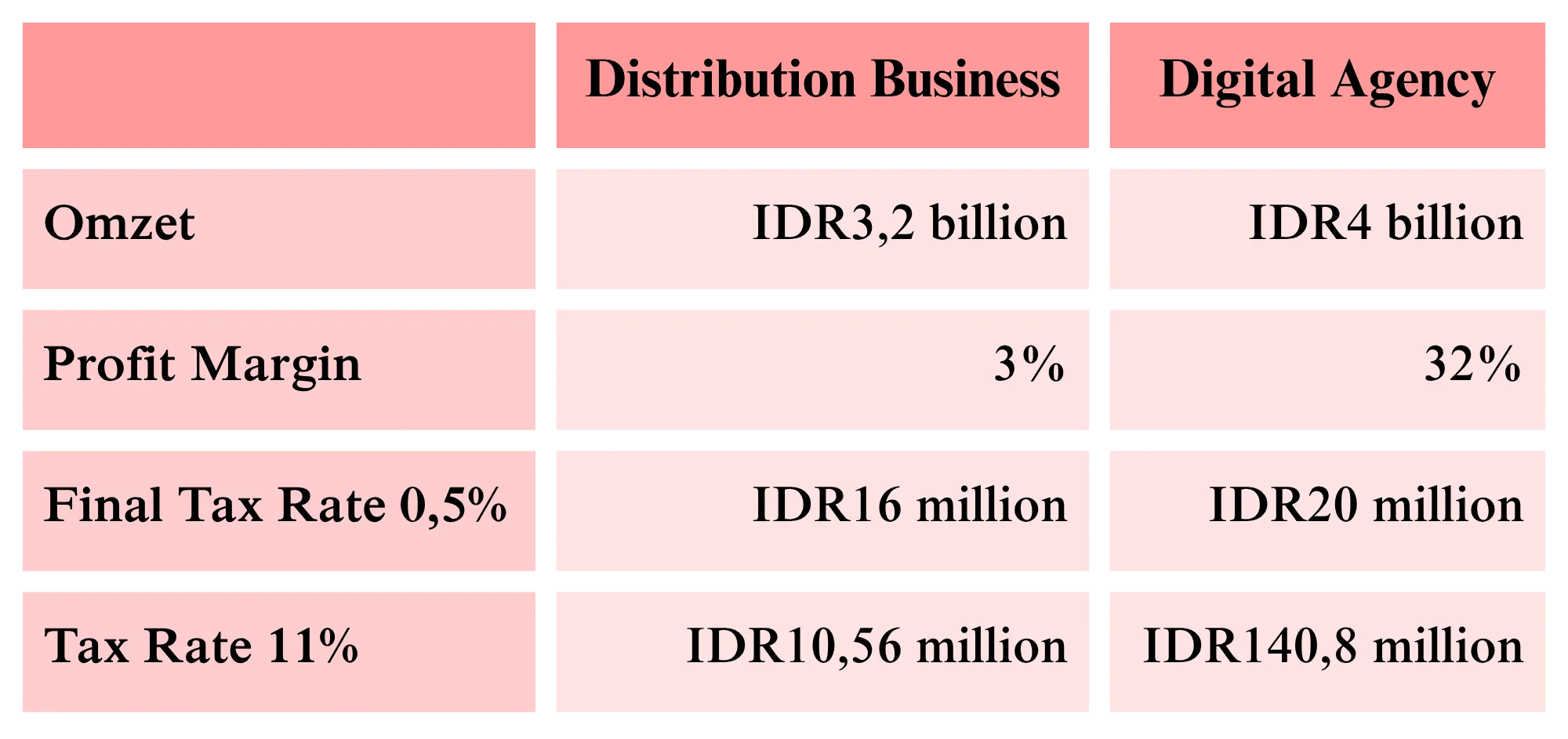
These illustrations show that Government Regulation No. 20 of 2026 does not affect every business in the same way. Therefore, companies should evaluate their revenue structure, profitability, and tax position before determining the most appropriate tax strategy.
The Role of a Tax Consultant
Government Regulation No. 20 of 2026 highlights that tax compliance extends beyond filing tax returns. Businesses should also ensure that they apply every available tax facility in accordance with the applicable regulations. Therefore, reviewing the business structure, income sources, and tax position has become increasingly important. Such a review helps businesses minimize risk while optimizing available tax benefits.
In this environment, a tax consultant serves as a strategic business partner. Tax consultants help businesses understand how regulatory changes affect their operations. They also assess eligibility for the 0.5% Final Income Tax rate. In addition, they prepare tax burden simulations, conduct tax reviews, and evaluate business structures. They then develop tax strategies that align with each business’s characteristics and the prevailing tax regulations.
As a tax consulting firm, KJA PT Synergy Ultima Nobilus provides tax advisory, tax review, tax planning, tax compliance, and tax reporting services. The firm also assists clients during tax audits and tax dispute proceedings. By combining compliance with practical tax efficiency, KJA PT Synergy Ultima Nobilus stands ready to help businesses navigate regulatory changes and support better business decisions.
Contact us today for further consultation.