- Phone: (031) 849 5566
- WA: +6282140060234
- Email: [email protected]
- Hours: Mon-Fri, 8am - 5pm
Understanding Database: Definition, Types, and Their Role in Business
Over the past several decades, rising transactions, customer numbers, and operational activities have increased the need for effective data management. Data across separate systems can create duplication, inconsistencies, and information delays. Therefore, a database has become a critical part of business infrastructure. It improves operational efficiency, integrates business processes, and supports data-driven decision-making.

What Is a Database?
A database consists of organized and interconnected data within a system. This structure enables companies to store, access, manage, and update information efficiently.
In business, a database provides a foundation for various company activities. Companies can store customer, sales, inventory, employee, and financial data within one database. Furthermore, different business functions can access this information according to their needs and authority.
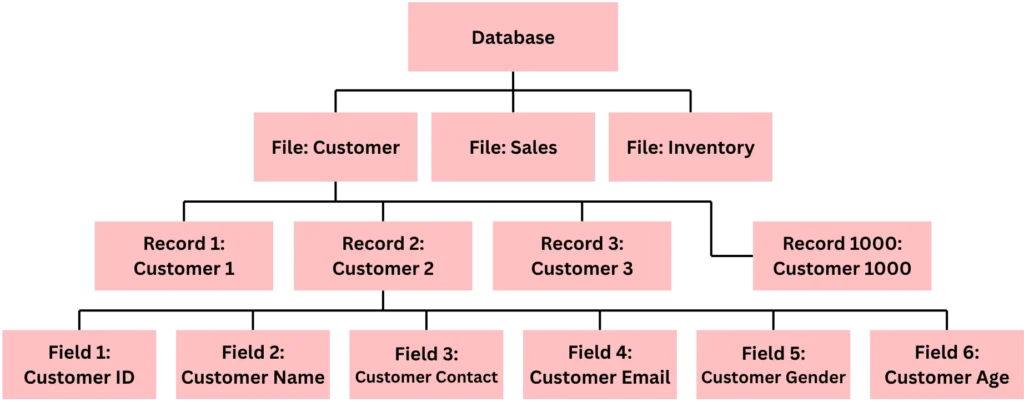
The illustration above shows a data hierarchy that helps explain the structure of a database. A field stores one specific attribute, such as a customer name, phone number, or address. Next, several fields that describe one entity form a record, such as a customer profile. Then, several similar records form a file, such as a customer data file. Finally, companies create a database when they organize and connect these data elements systematically.
Also Read: The Strategic Role of Flowcharts in Accounting Information System Design
Why Is a Database Important for Companies?
As businesses grow, data volumes and complexity also increase. Therefore, companies need data infrastructures that support operations and informed decision-making.
Without effective data management, companies may face data duplication, inconsistent information, and delays in accessing critical data. Consequently, these challenges can reduce operational efficiency and complicate coordination across business functions.
For example, sales departments use customer data to manage customer relationships. Meanwhile, finance teams need the same information for billing activities. Operations teams also use customer data to fulfill orders. However, each function may maintain separate customer records. When one system updates customer information, other systems may not receive the same update. As a result, inconsistent information can emerge and hinder cross-functional coordination.
Therefore, a database helps companies manage information in an integrated manner. It also supports diverse business requirements. According to Romney & Steinbart (2015), key database benefits include:
- Data Integration
A database connects different data sources and enables business functions to access integrated information. - Data Sharing
A database enables authorized users to access and use information according to business requirements. - Minimal Data Redundancy and Data Inconsistency
An organized data structure helps companies reduce duplication and maintain consistent information. - Data Independence
A database separates data from applications. Therefore, companies can develop systems without changing the entire data structure. - Cross-Functional Analysis
A database connects data across business functions. Consequently, companies can analyze business performance from a broader perspective.
Types of Databases
Companies have different data requirements based on their business characteristics, data volume, and system needs. Some companies manage structured transaction data and require high levels of consistency. In contrast, digital businesses may handle large data volumes with diverse and dynamic formats.
Therefore, companies use different approaches to manage their data. Today, two common approaches include SQL (relational databases) and NoSQL (non-relational databases).
- SQL (Relational Database)
SQL (Structured Query Language) manages data through a relational approach. This approach organizes information into tables with rows and columns. Each row contains information about one entity, while each column represents a specific attribute. For example, a customer table can contain names, addresses, and customer numbers.
SQL databases use a primary key to identify each row uniquely. They also use a foreign key to connect data across tables. This structure helps companies manage related information systematically. Furthermore, companies can search, update, and process data according to their business requirements.
- NoSQL (Non-Relational Database)
NoSQL (Not Only SQL) uses a non-relational approach. It does not rely on traditional tables with rows and columns. Instead, this approach provides greater flexibility for storing data with diverse structures and formats.
NoSQL supports several data models, including document, key-value, wide-column, and graph. For example, a document model can store various customer details within one document.
Because NoSQL provides a flexible structure, it can support applications with dynamic data requirements and large-scale data. Furthermore, this approach suits companies that manage data structures that continue to evolve.
In addition to SQL and NoSQL, companies can use other database approaches. These include hierarchical, network, and object-oriented databases. However, companies typically use these approaches for more specific requirements. Their suitability depends on the system’s objectives and business context.
Conclusion
A database provides a critical foundation for business infrastructure. It helps companies store, manage, access, and integrate data more effectively. With structured data management, companies can reduce duplication and information inconsistencies. They can also improve operational efficiency, strengthen cross-functional coordination, and support data-driven decision-making.
If you need support in developing a data management strategy, selecting the right database approach, or building an integrated information system, KJA PT Synergy Ultima Nobilus can help — Contact us for further consultation.
Reference:
Romney, M. B., & Steinbart, P. J. (2015). Accounting information systems (13th ed.). Pearson.