
- Phone: (031) 849 5566
- WA: +6282140060234
- Email: [email protected]
- Hours: Mon-Fri, 8am - 5pm
Firm Splitting and Firm Bunching: The Rationale Behind the Tightening of Indonesia’s 0.5% Final Tax Regime for SMEs
The 0.5% Final Income Tax regime for taxpayers with certain gross turnover supports Micro, Small, and Medium Enterprises (MSME) growth. It also expands the tax base and encourages voluntary compliance. However, a low final tax rate can also encourage tax planning. Some taxpayers use it to keep access to the preferential regime.
Indonesian tax authorities have focused on two practices: firm bunching and firm splitting. In some cases, these practices let taxpayers who already exceeded the eligibility criteria keep using the MSME final tax regime.
Therefore, the government issued Government Regulation No. 20 of 2026 (PP 20/2026). The regulation gives tax authorities a clearer legal basis for anti-avoidance measures in the MSME final tax regime.
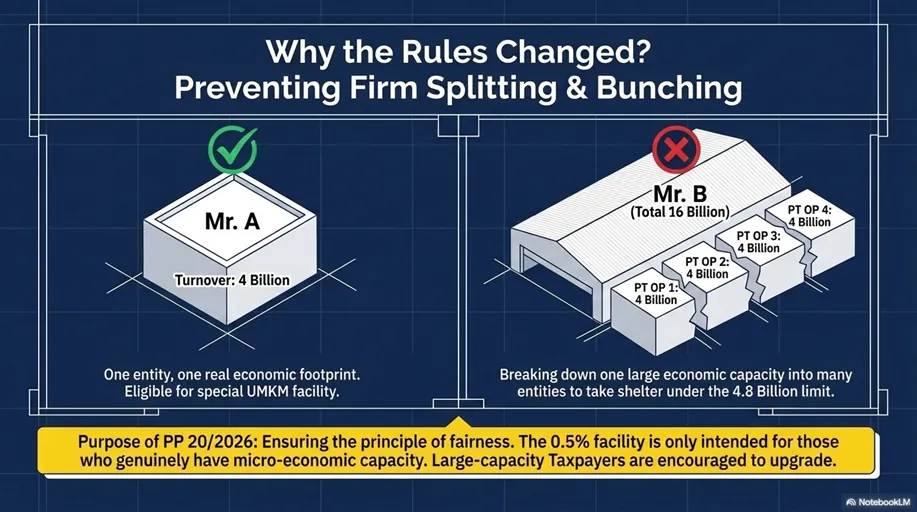
Firm Bunching: Managing Gross Turnover to Preserve Tax Benefits
Firm bunching refers to taxpayers who deliberately manage or limit gross turnover to stay below a threshold for tax incentives.
In the context of the MSME final tax regime, this practice can take several forms, including:
- deferring revenue recognition;
- adjusting the timing of sales transactions;
- reallocating transactions to certain parties; or
- limiting business expansion during specific periods.
Economically, these businesses may already have larger capacity than the policy targets. However, administrative arrangements and timing strategies can still keep them eligible for the 0.5% final tax regime.
The phenomenon of bunching has drawn wide attention in international tax literature. It creates taxpayer concentrations around statutory thresholds, or threshold effects. As a result, it can reduce the effectiveness of tax policy design.
Firm Splitting: Dividing Business Entities to Retain Preferential Tax Treatment
Firm splitting means dividing one economically integrated business into multiple entities or taxpayers.
Businesses often do this by establishing several entities or using several formally separate taxpayers that remain economically connected.
Indicators of firm splitting may include:
- common ownership or control;
- shared resources, assets, or employees;
- interconnected business activities within the same value chain;
- centralized management; and/or
- the primary objective of maintaining eligibility for preferential tax treatment.
From a tax perspective, these arrangements raise questions about economic substance. If the activities form one economic unit, separate access to tax benefits may conflict with the policy goals of the incentive regime.
Why Has the Government Strengthened the Rules?
The 0.5% final tax regime began as an affirmative policy to support taxpayers at a certain business scale. Therefore, the policy works only when the benefits reach the right taxpayers.
The government has identified cases where taxpayers still benefit from the 0.5% final tax regime, even though their aggregated gross turnover has economically exceeded the threshold. They achieve this through business structuring and transaction arrangements.
Such practices can cause several problems, including:
- mis-targeting of tax incentives;
- reduced tax equity among taxpayers;
- diminished effectiveness of fiscal policy; and
- increased risks of tax avoidance.
From a tax administration perspective, the law must let tax authorities assess economic substance, not just legal form.
Government Regulation No. 20 of 2026 as an Anti-Avoidance Instrument
Government Regulation No. 20 of 2026 strengthens the government’s efforts to apply the MSME final tax regime more accurately and effectively. The regulation bases eligibility on economic substance, not only administrative form. Moreover, taxpayers who do not qualify may lose the facility and face retroactive tax assessments.
Through this strengthened framework, the government aims to:
- prevent firm bunching and firm splitting practices;
- ensure that business activities are appropriately aggregated;
- strengthen anti-avoidance measures within the tax system; and
- preserve the fairness and integrity of tax incentives.
This approach aligns with international tax developments. Those developments increasingly emphasize substance over form and anti-tax avoidance rules in tax incentive administration.
Implications for Taxpayers
For businesses, especially corporate groups with multiple entities or complex ownership structures, these changes highlight the need to review business structures and tax incentive use.
Key areas require attention:
- ownership and control structures;
- economic relationships among entities;
- operational management and resource allocation;
- revenue recognition practices; and
- the commercial rationale for separating business entities.
Periodic reviews of these areas help ensure that MSME final tax use remains consistent with tax rules. They also help taxpayers withstand scrutiny from tax authorities.
Conclusion
The practices of firm bunching and firm splitting show the challenge governments face in directing tax incentives to eligible taxpayers. Therefore, Government Regulation No. 20 of 2026 strengthens the rules on tax incentive use. This reform aims to protect state revenue and preserve the effectiveness, fairness, and credibility of the tax system.
For taxpayers, these changes are an important reminder. Tax compliance reviews now go beyond formal requirements. Tax authorities also examine the economic substance and commercial purpose behind a structure or transaction.